 Skip to content
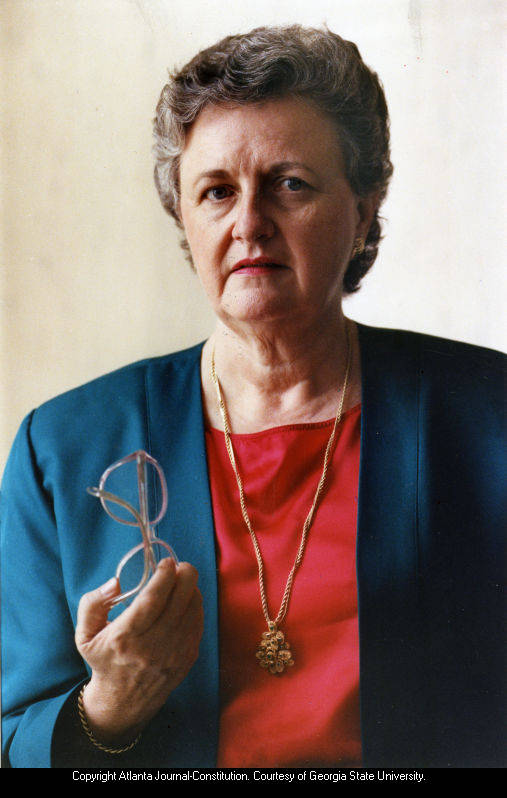
Film Inquiry spoke with the three women behind The Other Roe, a 16-minute documentary about Atlanta lawyer Margie Pitts Hames and Doe v. Bolton to discuss the history that has been overlooked, and why the film comes with an accompanying curriculum. We spoke with Wendy Eley Jackson, (writer, director and producer), Ann Rose, (producer and Margie Pitts Hames’s best friend), and Donna Hames Robinson (EP and Margie’s daughter).
This interview has been edited for clarity.
How the film began
Since there are three here, could each of you introduce yourself and what you do?
Ann: I’m Ann Rose, and I was Margie Pitts Hames’s best friend in the eighties and nineties. I’m still in the abortion industry, and I have a website called AbortionClinics.com. Over the years I kept googling Margie and Doe v. Bolton, and hardly anything came up. That frustrated me, because Margie was such an important figure in her time, but she died before the internet, so a lot of her story was hidden.
I connected with Donia during the pandemic and told her this really bugged me. We needed to resurrect Margie’s history and show how important she was to abortion rights. We started informally talking to a few people. We knew there was a story there but not what to do with it. Donia can tell you how she hooked up with Wendy.
Margie was a phenomenal, swashbuckling figure in Atlanta in the seventies, eighties and nineties. She was a civil rights lawyer, and she was on TV all the time. I felt blessed to have her as my mentor and friend, and we’re grateful we met Wendy and could bring her story to life. Now when you google Margie and Doe v. Bolton, there’s tons of stuff, which is what we were trying to do.
Donia: In short, we’re trying to bring my mother back, which sounds kind of weird. She’s been gone 30 years, but the work she did held for 50 years, and then it got overturned. Doe v. Boltonis the sister case to Roe v. Wade, and it matters historically to American women and to the liberties we’ve had for so many years that are now being taken away in strange and draconian ways. It’s 2026, and women are being persecuted, prosecuted and allowed to die. The whole point of this film, when you get down to it, is to save women’s lives.
We’re also trying to teach the public that knowing your rights is a good way to keep them, and the most we can do is get the information out. Wendy has crafted a beautiful film. It lets people understand not only that my mother and this case exist, but why these rights were put in place in the first place. Now the job is for the new generation to take them back.
Well said. And it’s a fantastic film.
Wendy: Thank you! I’m the writer, director and producer of The Other Roe. Most people know Roe v. Wade. Far fewer know that on the very same day in January 1973, the Supreme Court decided a second case, Doe v. Bolton, which came out of Georgia.
As a director, you shape how the story is told: the interviews, the archival research, the structure. This is my third short, and because it’s short, every frame has to count. As producer, I worked to get it made. I used my own crew, and I worked alongside our executive producers, Donia and Sam Pollard.
For me this is also personal. I’m Atlanta-rooted, and my father-in-law was the first African American mayor of a major Southern city, so Margie fits right into that world. It’s an Atlanta story about a woman who changed American law. Telling it with her daughter and her best friend at the table carried a lot of responsibility, and I’m very grateful for that.
Donia: Wendy and I were actually in middle school together, and neither of us knew the other was out here in Santa Barbara. I was looking for a director, a storyteller who could help me, and a friend said, “You two live right down the street from each other.” So we found each other, and it’s worked out.
Did you always know it would be a short?
Wendy: When we started this journey, the goal was always a feature film. Features take a lot of money. And as a historian and scholar of film and media, you have to think not just about the story but about what’s happening in the country and the world. We started this when America was shifting. We didn’t yet understand what the current administration, version 2.0, would look like, and that shapes where people put their money. Do I put it behind films, behind a political candidate, behind advocacy and lobbying? It always comes down to money.
Had we had more, this could very much be an extended version or a feature, and that would be wonderful. But for the 16 minutes it is, I think it tells a pretty sound story.
Margie in Georgia
Ann: She was a real character. The political landscape was so different then. Margie and I were down at the state capitol here in Georgia continuously, and we had friends who were Republicans, Democrats and independents. In the eighties and early nineties, Margie was welcomed in every room. People from every political party revered her as an expert on women’s rights, abortion rights and civil rights, and they gave her that kind of respect. I don’t think that happens much in politics anymore.
She crafted pretty much all the laws. She represented all the abortion clinics in Atlanta and helped us with legal affairs, with consents, and with prosecutions of protesters.
Right now the Georgia legislature has been taken over by Black Democratic women, yay, and we have an opportunity to repeal, hopefully, the heartbeat bill, which restricts abortion to six weeks, and open things back up. Keisha Lance Bottoms said a day or two ago that repealing it would be one of the first things she tries to do. She and Wendy are friends, she has a lot of support in Georgia, and there’s a good chance she could do it. Our film, and Margie, are at the center of that kind of revival. We want people to be motivated to take back our rights.
Why Margie was forgotten
Wendy: To me, as a scholar, the bigger question was why she was forgotten. History tends to keep one name, and another name can work against it. Those two cases came down on the same day, but in my research I saw Roe become the shorthand, then the headline, then the slogan. Doe gets filed away as a companion case, and even the name works against it. Doe is anonymous on purpose, so there’s no face to remember.
The woman who argued it, Margie Pitts Hames, was a Southern woman lawyer in Atlanta, at a time when the history of American law was mostly told about men and mostly from the coasts. She didn’t spend the decades that followed making herself the story. She went back to work. So her story wasn’t erased in one dramatic moment. It faded quietly, the way women’s stories so often do, while the people who got the headline kept it.
For the record, the Georgia pendant I’m wearing is the same one my dear friend, now Governor-elect Keisha Lance Bottoms, wears. For me it’s a reminder of the strength of the women who have made change in Georgia over the decades, and Margie is one of the central stories in that.
I was wondering if that was Georgia!
Wendy: It is. If you look at any photo of Keisha Lance Bottoms, you’ll see this exact pendant. It’s designed and made by a high school classmate of mine, Maria, who lives out here. She’s actually a neighbor of ours, Donia, right down the road in Malibu. Everybody’s asking where she got it. I tell them it represents the women, not just the men, but the women.
My job as a director is to find the human center. Margie was a lawyer, a mother, and a woman who lived most of her life in Georgia, though she wasn’t born there, and she took a case to the Supreme Court. Then you build the frame so an audience can understand and feel why she matters now.
Building past the screen, we also created a curriculum that runs from elementary school through law school. A forgotten story doesn’t come back because it’s screened once. It comes back when people pass it on. Every film has to ask the same question: who got left out of the version we were taught? The Other Roe is my answer for Margie Pitts Hames.
A Mother too
What was it like to make a film about your mother? That has to be beautiful, but also tough.
Donia: It was all of that, and I kind of signed up for it. I really did it for the psychological exploration, to get to know my mother better and understand who she was as a person. She died when I was 24, so I never got to know her as an adult.
She was also a tricky character. The swashbuckling thing that made her such a success as a lawyer was hard to grow up under, and hard to live with as her daughter. This was my chance to take all of those issues, humanize her and make her a real person.
What I’d love to get back to is this. We’ve all grown up at different times and ages, but what turns me on is seeing you, Kristy, and women who are younger and super excited about learning women’s history in America. You’ve grown up with the notion of “Wait a minute, history isn’t just what we’re taught. It’s all the other things we’re not taught, so let’s hear the rest of it.” We think we’re feminists, but you’re being raised in a culture with much more equality than we had. It’s awesome to see you turned on by women’s history, and I think that’s what will grow for this film.
For women, we’re learning that the only way to tell our stories is to share them among ourselves. Men can take it or not. They are no longer in charge, and we’re going to care for our own histories, our own sister stories. A friend of mine calls them “sisteries,” which I think is really cute.
“Sisteries.” That’s good.
Donia: Thank you for interviewing us and trying to find out more.
Of course, this has been such a lovely conversation. Donia, when you started this, was there anything that surprised you or stood out about your mother that you didn’t know before?
Donia: Yes, a lot. I learned a lot about my mother, and it helped me see her as a human being. It also helped me see my ancestry, and some of the lineage of abuse, including sexual abuse, that shaped her life. She also grew up dirt poor, and that shaped her life and her choices.
Upon reflection, I think anyone who can should explore their family, their histories and their ancestries. Look at the junk that’s been handed down to you that you need to clean up and deal with, and figure out how to deal with it. I’ve had enormous privilege to be able to do that. I’d encourage it, especially now. You can look at your own life and your family’s history for your own psychological benefit, to grow as a human being, and I think that’s healthy for everyone.
I also think it’s super important to look at history so you can learn how things happen. Why reinvent the wheel? If these people did it before and did it right, you don’t have to start over. We came up with this whole idea of looking at the logic in my mother’s case to help people in states with bans say, “Wait a minute, we want doctors to feel protected, to be able to talk to their patients without worrying that they’ll be prosecuted.”
There’s so much more I could say, and I want to respect your time. If you need to go, I understand, but we could sit here and talk to you for hours. None of us are shy.
What the film leaves out
Wendy: There’s something I wanted to share that doesn’t make the movie, and I really wish it did. With any documentary you have to ask what’s left out.
Before 1974, lenders could refuse to issue credit cards to single women. A married woman could get one only if her husband signed as co-applicant, and even then the credit history accrued to him, not her. That didn’t change until the Equal Credit Opportunity Act was signed in 1974.
Then there’s bodily autonomy for Black and poor women, which Margie was a real advocate for. As a journalist, you can look up Minnie Lee and Mary Alice Relf, who were 12 and 14 in 1973. These two African American sisters were sterilized by tubal ligation, without proper consent, at a federally funded family planning facility in Montgomery, Alabama. The Relf case helped expose thousands of sterilization procedures done without consent, the majority of them on African American women. The lawsuit that followed led to changes in federal regulations on involuntary sterilization.
Now look at what else was happening around then. Title IX passed in 1972, right before this. That same year Congress sent the Equal Rights Amendment to the states, and Shirley Chisholm ran for president. Yet federal protection against firing women for being pregnant doesn’t arrive until 1978.
So when people hear 1973, they think of Roe. But picture a woman who can’t get a credit card without a man’s signature and can lose her job for being pregnant. Women on the front lines, like Margie, were standing up for poor women in particular. If you were Black or a person of color, or even white and a poor woman in the South, the fight wasn’t only about the right to choose. It was about whether you would be allowed a choice at all. That’s the world Margie was working in from Atlanta, and it’s the fuller story The Other Roe asks us to see.
After the Election
Ann: Eleanor Smeal of the Feminist Majority Foundation says of the film that Roe wasn’t overturned overnight. It was pecked to death over 20, 30, 40 years, and to get it back, we have to unpack it piece by piece.
Now, with the election on Tuesday, there are at least ten states with Democratic governors, many of them women, who have a chance to overturn their state restrictions and maybe make abortion more legal across the country. If we can elect a Democratic president in two years and keep control of Congress, abortion can be codified nationally, and I think that’s the goal. We hope our film can help educate people about this history, so that we know the right needs to be revived, that we need to undo what happened four years ago with Dobbs, and that we need to protect women for the future.
This week brought some good news.
Wendy: It did. I happened to be in Atlanta for the birth of my first granddaughter this week, and I could feel the energy there. I also wanted to say that it won’t just be women. There are a lot of male feminists. My dear friend in Nevada, Berna Rhodes-Ford, has a husband who just became governor of Nevada, and I know he feels the same way.
We’re living at a very critical point. When you swing too hard to one side or the other, you get the pendulum swing, and that’s not what you want. What you want is consistency and pragmatism that let the foundations of equal rights stand for women, for all people, for people of color, for immigrants. You want those things reinstated and then codified, and only then can you really talk about the other things.
I wasn’t born into a political family, but I definitely married into one. When we talk about The Other Roe and what Margie says, and I’ve learned even more since we finished the film, you have to understand who is most vulnerable. One of my big takeaways is that Stacey Abrams actually studied Margie Pitts Hames. Born and raised in Mississippi and living in Georgia, she understood that what Margie did has to continue for all of us.
I’m happy the film at least starts to introduce those ideas. With the educational curriculum, I hope people keep talking about this and see it as a right that no one should lose, rather than something a few men would like to see gone.
Donia: What I think we’re also seeing, because of the blue wave, is a lot of people rejecting the shame around abortion. We can call it medical treatment or we can call it abortion; it doesn’t much matter. Women’s health care needs to be as equal as men’s. We’re all waking up to the fact that the history of medical care in this country and the world has been very patriarchal, and women have been denied equal opportunities for research, access, all kinds of things.
My point is that when women stand up and say we don’t need shame around this anymore, and we won’t accept men trying to slime us with it, things can actually get done. In my opinion, a small religious sect has tried to take over this country, and the blue wave was a huge rebuke of that. There was this feeling of, “Oh my God, does everybody feel this way?” Now we’re realizing that nobody does except a tiny minority that has found its way into power, thanks to the white-man patriarchy thing. They’re trying to take us back over religious opinions and moral dogma, things they’ve made up in their heads to control women. It’s all smoke and mirrors. They’re the dinosaurs, and the rest of us are realizing we have a lot more power than we think.
The fact that women are in charge as much as they are now makes me feel so empowered. I’m so impressed, and I’m super excited that things are going to shift in a big way.
Margie in the room
Ann: With Margie and her story, there’s so much more. She was a multidimensional person, and there are hundreds of stories out there about her influence and her activism. We could probably do 20 films on her alone. Donia was still in the womb when Margie argued the case, so this is a great chance for Donia to rediscover her mother and understand what an amazing influence she was.
I have encounters I could tell you about, like Margie with Ruth Bader Ginsburg. They were both on the national ACLU board and were friends, before Ginsburg was a Supreme Court justice. Margie was involved with Andy Young, with Wendy’s father-in-law, Maynard Jackson, and with Jimmy Carter. Donia, you can tell the stories of Jimmy Carter and his kids coming over to your house, and Margie and Jimmy sitting there having a drink and talking politics while you kids played.
That’s a real testament to Margie’s inclusivity. She could talk to anybody, and they respected her. You could walk into a room with Margie and she’d be inundated with people who wanted to talk to her and learn who she was, what she thought, and how things could change and be better for people.
If anything, that’s what I want our film to get across, and I wish we could add more of it. We want to inspire the younger generation about how politics can and should work. People are going to have different ideas, but you come together and do it kindly. You’re respectful of each other’s opinions, and you work together. The whole point of politics is not fighting, holding your breath and stomping your feet like little children. You come together like grown-ups and find solutions. Talking to people with different opinions and ideas is the only way, because if you think your way is the only way, you’re going to be wrong. You have to understand more of what’s out there in the world to make it work for everybody.
We can talk about the past all we want, but we want the action to come from younger generations.
The Curriculum
The timing of this is great too and I love thet you’ve created a curriculum, thats so unique.
Wendy: It is. And, going back to what Donia said, for me as a filmmaker, a film plays for an evening. People get moved, and they talk about it on the way home. But we structured a curriculum that can be used in classrooms forever. Every semester, a new group of students can meet Margie for the first time. The story can’t just live on a screen. That’s not the way education works. I’m also a professor of media at UC Santa Barbara.
A documentary should change how we teach history. If a student learns about Roe v. Wade, it could be one line or a date. This curriculum shows that a woman lawyer argued before the Supreme Court, and we can’t leave that out. We have to teach students that history is made not only by a few famous names but by people like Margie, the professionals who get it done and take on the hard cases. It restores the context.
We built the curriculum alongside the film to give teachers the tools to go deeper: the primary sources, the legal questions, the human stories. It puts students in the position of asking the questions historians should have asked. Who gets to decide? Who gets left out? What name did we forget?
I teach screenwriting and storytelling at the university, so I see this every day. When young people find a story they were never told, they don’t just learn it. They start asking what else is missing. That’s the real goal: to give them the habit of looking for the rest of the story, because it’s never in one answer. Margie isn’t here to speak for herself, and her story was nearly lost all at once. Putting it in classrooms is how you make sure it isn’t lost again.
I’m the daughter of a Tuskegee Airman who was one of the founders of the organization that made sure the Tuskegee Airmen were in every history book. So think about the film playing on Wednesday night versus a curriculum that can live in classrooms for years. We built it so that students learn not just Doe but the woman from Atlanta, just as they’ll know that Keisha Lance Bottoms is the first African American woman governor of the United States. Well, who was the woman who stood up in 1971 and reargued in 1972? That’s Margie Pitts Hames.
The question historians should ask themselves, even with a PhD and all that research, is who was behind making sure this story was not told. Then you find the two women who made sure it was told: Ann Rose and Donia Hames Robinson. I’m nothing but a conduit for education, and my platform is media. So this was a win-win for me.
Doe versus Roe
Ann: I think we also need to back up and explain the difference between Roe v. Wade and Doe v. Bolton. Roe was one person suing for her right to an abortion, to make abortion legal. Doe v. Bolton was a class action. The plaintiffs included doctors, lawyers, nurses and one woman, Mary Doe, who needed an abortion. Doe was about access. Roe was about legality, but there’s no legal abortion in practice if people can’t get to a clinic, or if there are no clinics. So Doe protected the right to abortion, in terms of access and people being able to get to clinics, for 50 years.
What I said earlier is that over the years, states pecked away at it. You can only go up to 20 weeks. You have to have parental consent. There were more barriers, exceptions only for rape, this and that, and people let each peck go by. We should have fought tooth and nail against every little thing that threatened Roe and Doe, and we didn’t. Now we have to regroup and peck it back into existence.
Are there any final thoughts you want to share with our readers?
Ann: I think we’ve covered most of it. I hope this can bring change in other countries too, because women’s rights are being taken away elsewhere as well. You see in the film that the things Margie said 30 and 40 years ago still apply today. She points her finger and says there’s no abortion up to birth. That just doesn’t happen, and she said it 40 years ago, yet people are still making those accusations. It’s interesting to see that things haven’t really evolved. What she was fighting for back then still has to be fought for today, and she was very unapologetic about it. People need to know that.
I’ve said to one group that you never know what one person can do. I don’t mean “little person” in any sense. Everybody is a big person in my eyes. But one person can make an awful lot of change. A woman in Tennessee couldn’t get an abortion for a 20-week pregnancy with a fetal anomaly and had to go to New York. She came back, told her story, ran for office four years ago, lost, and has just won a seat in the Tennessee House. The Tennessee House is now controlled by Democrats, and she is one person who went through something horrible and decided to do something about it. So whether you’re educated like Margie or not, rich or poor, whatever your background, you can have an impact on the world. Don’t discount any little thing you do in life.
Wendy: I’d like to add something. Being in Atlanta and talking to both my Democrat and Republican friends, I’m convinced this will not happen with Democrats alone. It can’t. That’s not the way the nation is built. You have to have a balance. Any law, or any law removed, will require a balance of power. Anything without a balance of power will eventually get chipped away at again.
I’m sure you’re hearing unified voices, but I want to make this distinction. We believe we have people who can make a difference, and it’s still important to have a very healthy dialogue across the aisle, whether you’re a Republican, a Democrat or an independent. I don’t care which. I still know young people, some I spoke to in Atlanta, who didn’t vote at all. How do you reach them? Some people are squeamish about the word abortion. Because they lack education about it, they equate it with something else. That’s why I stress, as a storyteller, that when people find a story they were never told, they want to know more. When you segregate the story along party lines or fundamental religious beliefs, you will not achieve your goal.
My purpose is to give everyone who sees this film the chance to understand what was missing. It’s up to you to do your own research, and our job is to provide the structure that makes that possible. We want young people, who are our future, to get the habit of looking for the rest of the story, not just one answer.
People are not moved by emotion. People are often moved by logic. We’ve watched this whole country get worked up on emotion for the last two years, and we’ve imploded. Margie’s case is a much bigger story than any one issue. When you look at the people who tried to chip away at something they thought would never resurface: old bones always speak.
I’ve talked to many documentarians far more experienced than I am, and it all comes back to the same thing. Even Jimmy Chin, who made Meru and all the other big docs he’s known for, and has a new one on Mount Everest, will tell you it comes down to what’s missing and why.
We’re telling the story of a woman, but that isn’t enough to put her in the history books, because you move people for a moment and then it’s gone. If you create a pathway to understanding why, you can raise advocates who make sure things stay legal and that rights can be restored in the states.
I can tell you that emotion only moves the needle for the person shouting. I’ve learned that the hard way in my brief 56 years. When I see people, including myself, moved by emotion, we’re not playing into the logic. You have to learn to table it, compartmentalize, and ask what you were really supposed to see in the situation.
In the film, you hear the justices, though only as recordings, because the argument wasn’t filmed. You hear Margie give her reason why. The way we closed it is with Margie saying, “I have a daughter, and she’s beautiful. I want her to be free as I am free.” That’s the message. What does freedom look like in America? Is it just for some?
This was a diverse crew. Our editor and DP is Jewish. We had Christians. I’m a Black woman. Our other executive producer, Sam Pollard, is an African American man. So we got very well-rounded input.
I want this film to live forever. As we think about how it’s distributed and who it’s distributed to, I think it should do more than tell Margie’s story. It should make us think about what was happening in the seventies, and what mistakes we made in the 40 years afterward that allowed it to be reversed. That’s the other part of the movie: what didn’t we do? Eleanor Smeal says it was nicked away. While it was being nicked away, who was asleep at the wheel? My father-in-law has a very powerful line: “The problem is never the bad guys. It’s that the good guys have gone to sleep.” Why were we sleeping?
Ann: I think everybody assumed Roe v. Wade was always there and would always protect abortion rights. So nobody, not Barack Obama and not Bill Clinton, ever pushed to codify it nationally. The ERA could have helped a lot, and it was stopped short of one state. It can be revived, but things like protecting women, women’s rights and women’s access were just put on the back burner.
Wendy: Let me add something as an African American woman. I’m very aware that the rights of white women far exceed the rights of Black women. To show how simple this is: Margie was born in what year, Donia?
Donia: 1933.
Wendy: So when she turned 18 and could vote, that was a very different situation from some of her contemporaries. When you look at how hard you have to fight to make sure everyone has a seat at the table, that’s who Margie was for me, and it’s one of the reasons she’s my hero.
Civil rights have already been taken away from people of color. Our voting rights are the ones that were taken, and then it spreads to everybody. So I’m constantly aware that unless something is codified, and I didn’t realize this until we started this doc, every right for a person of color or a poor person can be completely erased if a small group of people nips away at it. That’s why, to me, Margie is one of the biggest unsung heroes of the American legal system. There’s room to learn more not just about her but about the other women who did things we don’t know about.
I can’t imagine anyone not being interested in pursuing it, especially if you make more and put them in classrooms. That’s incredible.
Wendy: We’ll be pitching that in New York next year.
Donia: Yes, we will.
The Clinics Margie helped Build
Ann: To add to that, most people don’t realize that when abortion became legal, abortion clinics were invented on the fly. We couldn’t do abortions in hospitals, because generally hospitals wouldn’t let us. So we came up with the idea of doing them in doctors’ offices and clinics, and the abortion industry actually invented outpatient surgical care. Margie was at the forefront of getting us through that: getting proper licensure, getting the consents, making sure the facilities were properly equipped and the staff properly trained.
If you want to put it in those terms, the abortion industry invented outpatient surgery in this country. That’s a big deal. Before clinics, any kind of surgery meant a hospital stay of a day, two days, three days. With abortion, we were in and out in three or four hours. We started an entire industry, and we don’t get credit for it. Margie was at the forefront of developing that and making sure everything we did was legal and safe. It’s a big piece of American society that the legalization of abortion ushered in.
This is all incredibly empowering, and a lot. It’s an incredible film, and you’re all amazing. Thank you so much for your time and congrats!
Film Inquiry wants to thank Wendy Eley Jackson, Ann Rose, and Donia Hames Robinson for their time.
Does content like this matter to you?
Become a Member and support film journalism. Unlock access to all of Film Inquiry`s great articles. Join a community of like-minded readers who are passionate about cinema – get access to our private members Network, give back to independent filmmakers, and more.
Join now!


