 Skip to content
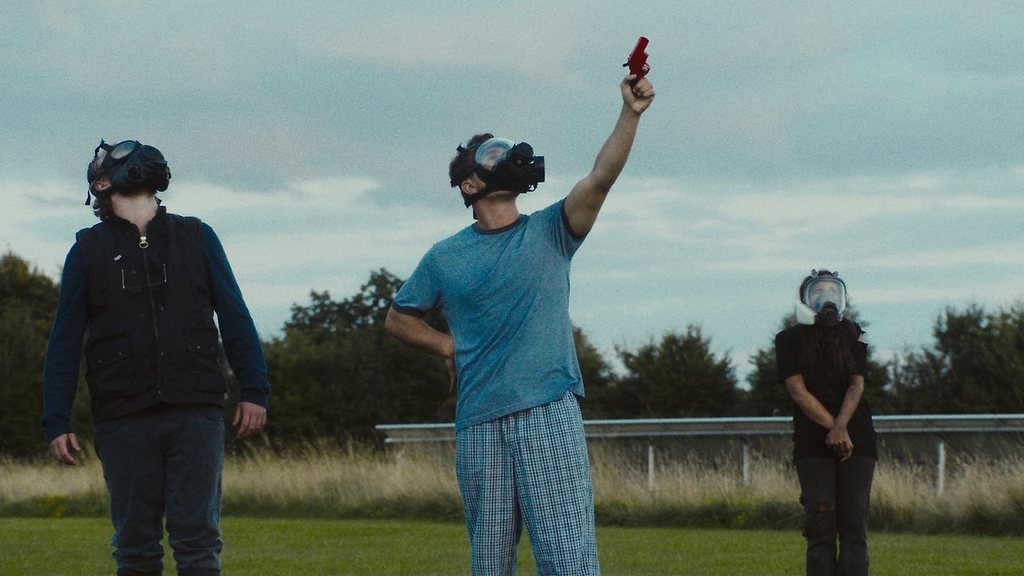
Here’s my take, or at least as much as I could gather in real time. Somewhere in the English countryside, during some unspecified and mysterious war, two survivors named Liam (Joey Bader) and Mel (Kaley McGregor) find themselves bloodied and speechless in an isolated cottage. They are taken in by Chester (Oliver Wolfe), a mysterious caretaker who bathes them, feeds them and slowly teaches them to talk again. This is a prerequisite. Getting there is an experience all its own, though, as Littermates opens in such a disorienting haze that it took me many, many minutes of runtime before I really figured out what was going on. Not a few minutes. a lot.
Thanks for reading this post, don’t forget to subscribe!
This disorientation feels deliberate, and once you settle into the film’s rhythms, it starts to pay off. At times the picture has that 70s and 80s grainy, analog texture that gives the whole thing a lifelike, unaltered quality, even though the aspect ratio does something weird and boxy with its 16:9 frame, which I found really tiresome, though I admit some of that could be my viewing settings. Either way, there’s a lot to chew on just in terms of how this thing is shot.
Tynham and Wolloson, making their debut here, clearly play in a soft mumblecore register early on, all frowning and cocky-looking and stooped, halting dialogue. Honestly, I’m not sure there’s a single line of fully functional adult dialogue in the entire first hour. This is not a knock. This is the point. Liam and Mel relearn basic communication under Chester’s tutelage, and the film fully embraces this regression, allowing the audience to feel as unsettled as its characters.
And here’s where things get really weird. Chester’s entire operation is based on what the film calls “nifties,” small tokens earned for good behavior that can be redeemed for small comforts, karaoke, hot tub time, dance parties, favorite meals. It’s a remarkably incisive piece of filmmaking that uses tokens as visual shorthand for the passage of time and the reestablishment of trust, but also a clearly, almost gleefully acting conditioning. It’s BF Skinner by way of a cottage in the woods, and the film knows exactly what strange laboratory conditions it depicts. A real paranoia hums even in the most intimate, tender moments of the cottage, and that tension is never fully resolved.
The relationship between Chester and his two charges reads as paternal, but here’s something that kept bugging me: these people all look like they’re decades apart in age, if that. It’s a really weird dynamic, and the film seems to know it’s weird, capitalizing on that discomfort rather than eliminating it. There’s a certain lineage of Frankenstein that runs through this story, more specifically Bride of Frankenstein, in the idea that a grown-up creator diligently transforms fully grown people into functioning human beings.
As Liam relearns the world, the adolescent unlocking phase spoke directly to the high school teacher in me, with all that wide-eyed discovery and testing of boundaries. But Littermates becomes truly subversive when it begins to tease apart Liam and Mel’s parallel awakenings. Maturity is like a quest for him. It’s like masturbation. There’s a lot packed into this abyss, and the film pulls it together for both the darkest comedy and the most uncomfortable truths, delivering a version of The Blue Lagoon, but in its late thirties, teenage innocence, which only makes the absurdity of the subgenre’s tropes more apparent.
I want to make it clear that this movie is very, very funny. Everyone involved is obviously having an absolute blast, and Bader in particular chews up every scene he’s given. is it too much Of course. But come on, look at the building. He understands the task, as the kids say these days. At one point there is a rock with “Liam is Cool” emblazoned on it. dead The dark humor of the film runs through almost the whole performance, I found myself laughing and immediately looked around, a little guilty about it.
This offense is earned because Littermates isn’t afraid to juxtapose all that comedy against at least one scene of real, intense suffering, and the tonal whip is strong even when it’s nasty. Thematically, the film works like Bugonia, daring you to call a bluff about what kind of film it really is, and then slapping you in the face the moment you do.
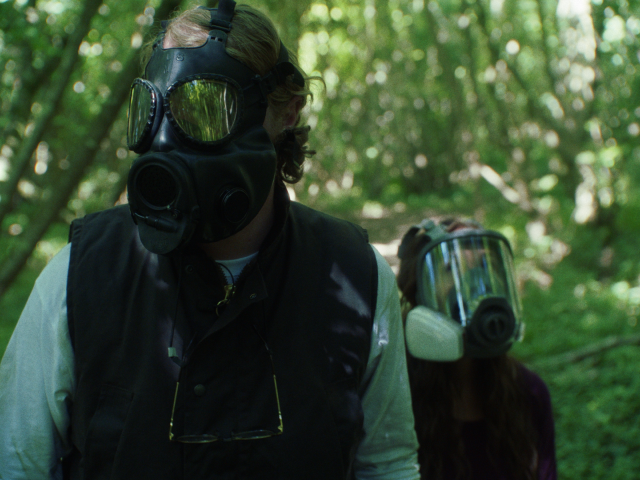
There’s an obvious Wes Anderson influence in the production design and deadpan compositions, but Littermates has too much genuine danger to ever feel pasty. This is a movie made for people like Fantastic Fest, full of landmines and daring the audience to step on each one.

Tyler has been Editor-in-Chief of Signal Horizon since its conception. He is also the director of Truman State University’s Monsters 101, a class that combines horror film criticism with survival skills to help middle and high school students learn critical thinking. When he’s not watching, teaching, or thinking about horror, he’s the director of debate and forensics in Kansas City, Missouri.


