 Skip to content
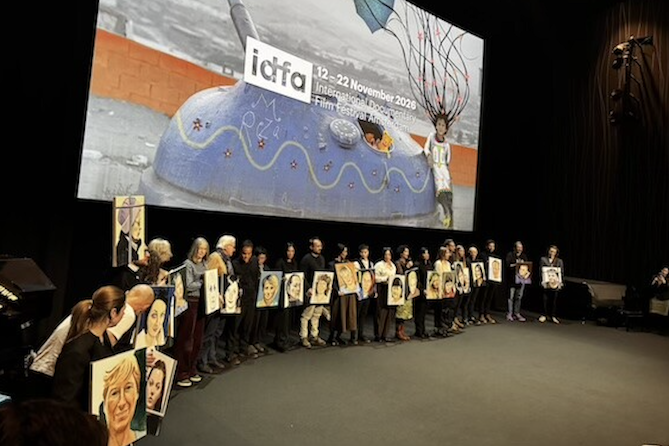

On Sunday, November 15, a public event was held at the Eye Filmmuseum ahead of the world premiere of Elvira Nievera’s new documentary, Women and War, which will be screened in international competition and sold out Rise and Shine.
The film follows four Ukrainian women who have endured horrific experiences – torture, sexual assault, long-term imprisonment, terror and death – following a full-scale Russian invasion in 2022. They are shown attending therapy sessions in the Carpathian Mountains as they try to come to terms with memories of loss and trauma.
According to the data of human rights organizations, more than 2,000 Ukrainian women remain capable of action. At the end of the film, one of the main characters, Yulia, who was held captive for two years, recalls what the prisoners who were finally released told her: “Please don’t leave us alone with Russia.”
The public action was one way of reminding the public of the plight of these prisoners and is the result of a collaboration between Nieviera and the famous Polish artist Bartek Kielbowicz. “I showed him the film and he was so impressed that we started thinking about what we would do.” The public held portraits of 33 women painted by Kielbowicz.
“You know you can’t touch a painting in a museum, but in my film, touch plays a very important role in women’s support therapy. In public action, touch also plays an important role. We want people to hold the paintings, pass them from hand to hand, and be able to touch them, hug them, spend time with them.”
In late 2022, Niviera heard about a trauma therapy program in Ukraine. “I was very shocked. Eight months after the start of the full-scale invasion, people were thinking about how to help women recover,” the director recalled.
His earlier documentary, Hamlet syndrome (2022) used a Shakespearean tragedy to explore the trauma experienced by young Ukrainians following the Maidan Revolution. A representative of the Ukrainian Women’s Foundation, impressed by the film, now approached her and invited her to find out if the trauma program was worth documenting. Niveira talked extensively with therapists. He wasn’t sure it would be possible to film their sessions unless the women and the therapists had complete faith in his motives. “I spent a few months getting to know the women and building relationships with them before the shoot.”
After the full-scale invasion, Niviera was deeply involved in humanitarian work in Ukraine. This made it easy for women to trust him. They knew he wasn’t just a filmmaker or a journalist who was there as an observer and would soon leave. He has already shown his long-term commitment.
From the beginning, the director and therapists set very clear ground rules. They agreed that there would be no filming of individual therapy sessions. “It would remain completely private, and it was very important to me that women have that private space.”
Instead, the documentary focused on group sessions and art therapy.
Niviera accepted that the welfare of women should always come first. Nevertheless, he became an “important part of the group” always helping, making tea, spreading blankets and trying to create a peaceful atmosphere. He was determined to make a positive contribution and not just be a film director who sat on the sidelines and watched what was happening.
“Of course, it was a very difficult experience. In the film, I tried not to give space to the perpetrators, but to focus on the journey to healing and what that means for women coming out of captivity.”
These women “continue to live in this constant state of fear, of danger, even after they are released, because they completely lose their sense of security. They cannot trust other people, even if they return to their families.”
They also often feel “emotionally and physically numb.” For example, Irina, a ballet dancer from Mariupol, found herself unable to dance after a terrifying experience hiding in the cellars. “The process of recovery is long and difficult. I realized that at first these women could not only feel joy, but also sadness or anger.”
During therapy, the director saw that women’s feelings “slowly come back.” It was an emotional and exhausting experience for him as well. “It was such a big decision. I needed to make this film,” he admits. “Of course there were times when I doubted I could do it.”
So he developed a new way to relieve “pain, anger and helplessness”. He was breaking plates. “Ukrainians have been at war for so many years that they know how to deal with pain. A very close Ukrainian friend of mine recommended this to me.”
The director admits that while making the documentary and learning “the terrible things people can do to each other, you start to lose faith in humanity. That was one of my motivations for making the film, as well as showing the inner strength and resilience women have to overcome the worst evils.”
Women and war is a Polish-German-Ukrainian production, produced through the production companies Ventana Film, Telemark and Art Dialogue. “The first year, 2023, I was on my own with no producers, but that’s when I got a big development grant from Chicken & Egg Films.” At the end of 2023, he successfully applied for German state funding – and the project has since built up support.
Niviera always makes his films in an observational style. He wanted the camera to be close to the women and to shoot in an intimate style – but without making the subjects uncomfortable. His partner Piotr Rosolowski is DOP. Women knew and trusted him from the beginning.
“During the shoot, the camera often stops, allowing space for silence, gestures, faces and body language. The changing seasons are also very important because they show the passage of time and reflect the inner changes of women.”
There is a stark contrast between the “peaceful tranquility” of a therapeutic retreat in the mountains and the turbulence of women’s lives.
All four subjects were at the world premiere in Amsterdam. The Ukrainian premiere of the film is planned for next summer, and then it will travel around the country. The German edition is handled by Real Fiction and will have its Polish premiere at Millennium Docs Against Gravity in May. The director is currently busy trying to establish a long-term trauma therapy center in Ukraine. “We already have the land and an architect is working on the design. With this film, I want to offer the audience a way to contribute and support us.”


