 Skip to content

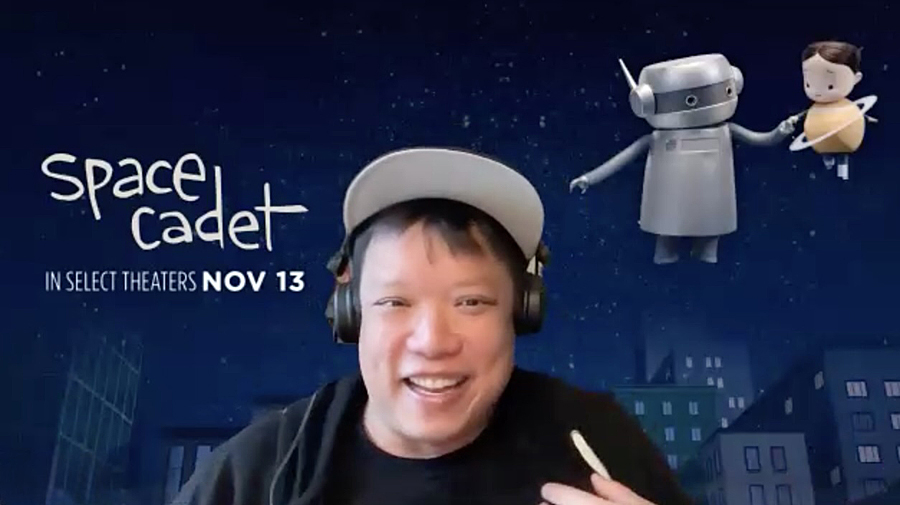
Popular DJ, musician and songwriter Kid Koala (Eric Sun) has made his first animated film – the sweet “Space Cadet”, which will be released on November 13th in selected cinemas. Based on his 2011 graphic novel about a girl named Celeste and her caretaker, the Guardian Bot. (This Animation Scoop Q&A Edited for length and clarity. (Image credit: Viva Kids)
Jackson Murphy: Congratulations on the film. It’s beautiful, it’s sweet, and I know the graphic novel that you did came out in 2011. So how much has this story meant to you over the past 15-plus years?
Kid Koala (Eric Sun): It means a lot because… life will be life. So I wrote, originally it was one of those moments in life where you just reflect. Basically, my grandmother passed away recently, and then I was waiting for my first daughter to arrive. So my brain was just time traveling. I went back in time, trying to remember all the special moments I had growing up with my parents and grandma, and then I thought, “Here’s this next new adventure with this little person joining our circus,” and let’s see where it goes. And actually, that same daughter is now going to college. That’s how long it takes to make an animated movie sometimes. The people I’ve met and the artists we’ve met and worked with on this project… it’s been a real blessing. I’m so excited for people to see what they’ve done.
JM: This is great. This story has great power. You talk about memories. There are many memories in this. It’s a non-dialogue film, you show memories and use them as a guide throughout the story. How interesting was that for you, using memories, flashbacks, even in the drawings – which is very clever how you do that – to tell the story of Celeste and her guardian bot?
KK: It’s great because it’s a way to fast-forward through time and kind of piece together the relationship that Robot and Celeste had with each other in a not entirely linear way. You can tell they have that special bond with that quick turnaround. And if I think about my childhood, it would be these little contacts, where, say, my father suddenly told me that he could draw, and then he showed me and taught me how to draw a battleship, when I remember, as a child. And in that moment, he went from, “Oh, that’s just my dad,” to, “Wait, this guy’s an artist? So what? He can teach me how to draw?” And suddenly there was a paradigm shift in my young brain where this would happen. Or my mom teaching me how to make things out of paper and how to bind a book for the first time. And those moments, if you ask my parents now, they’re probably like, “I don’t remember doing that.” But as a child, it literally started setting me on this path to art. It’s amazing. So I think this movie is trying to celebrate sometimes those ephemeral moments you have when you’re growing up that really open up the world to you.

JM: Absolutely. The power of creativity and those memories and connections with family members and loved ones. Guardian Bot cares about Celeste, this young girl who goes to school to explore space, and for good reason. When you were young, were you always fascinated by space, walking on the moon and things like that?
KK: Not so much when I was younger, but when I was in high school, I had a physics teacher, Mr. Bascom, and I remember him giving this lecture where he said, “Okay, you know that the light coming from these stars is actually several, sometimes millions of light years away, and it takes a long time to get to your eyes tonight. And then everybody’s jaw dropped to the floor in the whole class, and then the buzzer went off, and I was like, ‘Okay, okay. Eat lunch.’ I just walked out of that class and I said, ‘I need to take a long time and think about this.’ But ever since, the connection between the past, the present, the space, the vastness, the meaning of life, your place in the universe, all these things have been running through my mind since that very lecture. I think that’s when I started looking up at the stars and seeing what it meant to me.
JM: You have this relationship that you show between Celeste and the Guardian Bot that is so sweet and so touching. Were there any challenges with how you wanted to present it? What were your goals to present… that connection that they have before you had to separate the story a little bit?
KK: I think the personality, because there’s no dialogue, it’s really about how they move, obviously. And finding their “language” about how they move was the first challenge. But once we figured out how we were going to do it, it stayed true to the characters, and by that I mean that’s a lot of real… animation restraint. The first animation tests were pretty squishy and squishy, with eyebrows popping out of the forehead and all that. Then I realized, “I don’t know if this is the type of storytelling that needs this kind of animation.” So I think I’m a little more reserved. But doing so actually hits harder emotionally. So I think their characters, that was the biggest challenge… trying to find that origin, the language of how they move. Once that happened and all the animators realized it was great what they were able to create.
JM: He goes on his mission and the Guardian Bot stays behind and a lot happens. I love character design. City design, look, feel. They go to the canteen. It’s very retro inspired. Are you inspired by the retro yet futuristic look presented here?
KK: Absolutely. I actually have a dining booth in my studio that we bought from a real diner that was closing and we said, “Oh, we need this in our house.” So that’s where we do most of our meetings in terms of drawing, sketching meetings and things like that. But yeah, the design I have to give it to Corinne Merrell who is our art director and Lillian Chan who is our production designer. They wanted it to remain developed. So Corinne also worked on “The Little Prince”. He did all the paper sets for (director) Mark Osborne’s The Little Prince. He makes things with his hands. Even though it’s a CG film, we’re all analog by nature. Lillian Chan, our head of story, is actually a hand-made animator. Corinne tried to design spaces and even apartments with paper textures and build them in real life as a starting point, then trying to figure out how to transfer that into the realm of CG in a fluid way. So it’s nice.
JM: It’s very cool. I still think about that movie “The Little Prince” more than a decade later, and I think I’ll think about “Space Cadet” too. I would describe this movie as elegant. There is elegance in the atmosphere and especially in the music. Obviously, this is your expertise, right up your alley. Did you really want to create this elegant atmosphere? Because I think, especially the parents and grandparents who are going to watch it, they’re going to really appreciate this movie.
KK: Absolutely. Already involved in the scenes when Mylene (Shole) was writing, just to be in the script zone… she would pick a song from an old songbook, say “They Can’t Take That Away From Me”, or “Moon River” or a tune like that. And it just kept him in the emotional zone while he was writing, and then when it came time to score it, I had to make these kind of retro-futuristic versions of it with all the gadgets I have in my studio. But then I also still wanted that kind of nostalgic timelessness. I invited some of my favorite singers on the planet – Emiliana Torrini, Karen O, Ladybug Mecca, Trixie Whitley, Meaghan Smith, Martha Wainwright – to come and do interpretations or write other moments of the songs into the score. They have such wonderful comforting voices, so I think it would be perfect for any scene to have their vocal presence in the score.

JM: The music is great. Celeste’s science and research is very important to what she discovers throughout the film. Obviously, you need science and research when it comes to creating an animated feature. What did you learn most about this experience from a technical standpoint, or what surprised you about this experience of making an animated film?
KK: I was surprised how much all the sections affect the scene. So from blocking, to camera moves, to animation, to texturing, to lighting, at any given moment they can completely change the whole feel, joke or poignancy of a scene. So once everything was in sync, I realized that you just give them space to make that scene the most painful or exciting or funny or tense. It was a new thing for me because I came from drawing where you do a panel and a comic. You choose the camera, you do the lighting, you have a keyframe pose for your character. So I kind of thought it all came together. But on a production like this, it’s actually a different team of people who might be working on it eight months from now. So when you first see it, it might just be cubes and pyramids or cones or something moving in Z space. And you’re like, “What am I looking at now?” It’s like, ‘No, this is your scene.’ I’m like, “Ow.” So it took me a second to figure it out. But then also in terms of time, I think I went to be more of a musician. I was like, “Hey, let’s try to roll our shoulders a little bit every two or four times.” Then the animators would just roll their eyes at me and say, “What are you talking about?” I’m like, “No, just listen to the music. It’s a walking pace.” And then we learned that we should speak within the framework. So I actually became very fluent with frames. Every 16 frames, at the upper limit of the shoulder, and this is a kind of time. I’ll leave the rigging and all that movement to the animators, but the actual locking in pace in some scenes was done this way. And I thought it was a challenge but also fun to learn. (laughs)
JM: Excited to handle more animated features? Are you ready for more stories? It was such a journey for you. Are you ready to move on to another animated feature?
KK: Absolutely. I think so. It was a lot of fun and I really think that the team that we put together for this… even at our party we were like, ‘I’m going to miss everyone here.’ It was a great experience working on this and making this movie together. So I hope so, absolutely.

JM: I think families will not only go see this in theaters, but to me it’s a nice comfort for a lot of families who can watch it over and over again. What does it mean to you that families will watch it over and over again and maybe get something new the second time around – and will the kids respond to the story the way I think they’re going to?
KK:I come from a music background, so the idea of listening to an album over and over again is not new to me. In fact, as you listen to more records, different songs start playing differently and become your favorites over time. With this movie, I hope it brings comfort to anyone who needs it or is going through something like a period of loss or grief, but at the same time they laugh together as a family. If I go back to my first experience watching a movie, it would be Charlie Chaplin’s Modern Times, my grandmother, parents and my sister all laughing, crying and on the edge of our seats watching the story unfold. Even then, when I was six or seven years old, I said, “You know, when I grow up, I hope I can somehow implement this energy.” Whether it was through film or live music, I just felt that connection. So absolutely, I hope people bring their loved ones and watch it together. I think that would be a great thing.


