 Skip to content
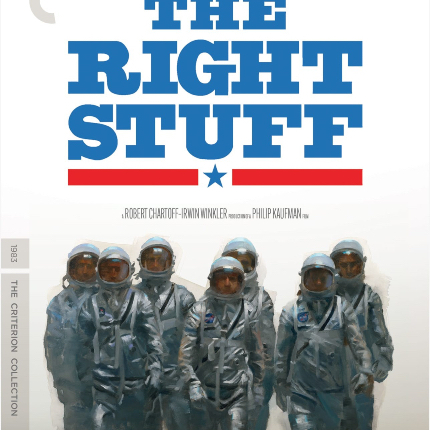

There are more stars in this picture than there are in the sky.
The Right Stuff (1983)
The film is available now from The Criterion Collection in a two-disc 4K Ultra HD version, as well as a separate Blu-ray edition.
Adapting from page to screen is always difficult, especially when the source material is well known.
Director Philip Kaufman rose to the challenge brilliantly, writing an adaptation of Tom Wolfe’s popular book, first published in 1979, that captured adventure, romance, excitement and danger in a film that lasted over 193 minutes, but felt like a rush of caffeine injected directly into the bloodstream. (There was, of course, a break during the packed, original theatrical showing I attended in October 1983, which was part of an extremely limited nationwide release.)
I watched The right stuff More times than I can remember since its 1983 release, played as an appropriate contrast/comparison to life in the United States of that era (ie Reagan’s America), and has been rewatched every time since.
I’m sure my childhood of dreaming of flying to the moon or going into space also biases me in favor of the movie, especially since by 1983 it had already been a decade since America’s last mission to the moon. We also knew the fate of some of the Mercury sevens, which adds to its grimness.

Watching the film again in the new 4K from The Criterion Collection made me nostalgic for the past.
Maybe it’s just me and my generation of viewers, but it’s hard to erase or replace the indelible memories of Scott Glenn, Ed Harris, Dennis Quaid, Fred Ward, Lance Henriksen, Scott Paulin and Charles Frank portraying astronaut-turned-test pilots. Or Barbara Hershey, Pamela Reed, or Veronica Cartwright as test pilot wives who are expected to sit quietly while their husbands are threatened with death every time they take to the air.

Still, it’s playwright Sam Shepherd as test pilot Chuck Yeager who creates an indelible figure. Shepherd has already impressed with a supporting role in Terrence Malick’s film Days of Heaven (1978) and his performance here as the taciturn Jaeger cemented his position as a cowboy poet of the highest order. I have seen The right stuff Many times and I can easily recall much of the dialogue, but nothing like this watching Shepherd gallops across the high desert on horseback or stands quietly outside a bar, alone or with his wife, Barbara Hershey.
Includes an excellent typed essay by critic and historian Michael Sragov. Sragow notes that the film is a series of episodes rather than following an overarching narrative, which I had never thought of before; I’ve always been fascinated by the emotional flow that writer-director Philip Kaufman creates, allowing the all-star ensemble to bring things to life like a choir of singers that Kaufman can randomly point to, making sure whoever he points to breaks into a big song.

Criterion’s new release features “a new 4K digital restoration supervised and approved by director of photography Caleb Deschanel, in 70mm 5.1 surround with a DTS-HD Master Audio soundtrack.” It looks brilliant, with colors and shadows reproduced with great fidelity. It’s shot on celluloid, not digital, so it’s not continuous, but the visual effects and (minimal) archival footage flow nicely, side by side.
Where it really stands out is the sound, which only flourishes The right stuff Can boom, satisfactory fashion. (My apologies to my apartment complex neighbors.)

Criterion’s 4K releases are typically two-disc editions, with the film on one 4K disc and the Blu-ray version of the film and extras on the second disc.
Here the film, which lasts 193 minutes, is only in 4K. The Blu-ray disc is entirely dedicated to extra features. What I noticed right away are the features that are there new Distinguish between features ported from previous releases that are italicized.
Criterion’s new, 2026 features. All are fixed in 2026 except the first:
— “A Visual History of the Academy with Philip Kaufman” (20:23). Recorded in 2019 for the Academy of Motion Picture Arts and Sciences Visual History Program Collection, Philip Kaufman is interviewed. The director was a fabulous storyteller; Here he talks about coming to the project; disagreement with original screenwriter William Goldman; talking to Jean-Luc Godard, who expected him to interrupt, but instead said, “I’ll do it if you don’t!”; attending a performance by poet and playwright Sam Shepherd, where Kaufman’s wife said, “There’s your Chuck Yager”; discussions with Jaeger; First meeting of Yeager and Sam Shepherd; Yeager’s warm words on the 20th anniversary of the film; and the wonderfully creative, if mysterious, visual works created by artist Jordan Belson.
— “Gary Gutierrez” (13:33). A visual effects supervisor talks about his role as a storyboard artist when Kaufman tried to sell the film to the Ladd Company. It became the biggest project for Gutierrez’s visual effects company. Kaufman decided they should go “old school” and not use motion control effects. Gutierrez describes in fabulous detail how the effects were created.
— “Mark Berger and Randy Tom” (19:22). Sound designers talk about their work on the film. They recall Philip Kaufman’s one-word description of what he wanted: “Loud!” It’s a lively conversation as fascinating as it is educational, as they look at selected scenes in the sound mixing studio and break down individual sounds, talking about what they wanted to achieve and how they did it. They also talk about the advantage of working in San Francisco away from Hollywood studios.
— “Stephen A. Rotter and Bobbie O’Steen” (18:55). Editor Rother talks to film editing historian O’Steen. Rotter admits he had limited previous experience. He spent 11 months on the film, focusing in particular on effects shots and shots of Chuck Yeager’s various flights. Along with three of his fellow elders, Rother received an Academy Award.

Ported on the 2003 Warners 2-Disc Edition Special Features:
— “gets it The right stuff” (9:09 p.m.). Narrated by Levon Helm. Director Philip Kaufman, producers Robert Chartoff and Irwin Winkler, and writer Tom Wolfe, along with director of photography Cullen Deschanel and the cast, talk about the development of the film and provide a behind-the-scenes look at its making.
— “T-20 Years and Counting” (11:27). Narrated by Levon Helm. Behind the scenes of post-production, special effects study (Gary Gutierrez), editing and music (composer Bill Conti). Director Cullen Deschanel, director Philip Kaufman and producer Irwin Winkler, as well as various actors, share their memories.
— “Real men The right stuff” (15:29). Tom Wolfe talks about writing the book; most of the film shows Chuck Yeager and the Mercury Seven astronauts talking about their memories of the program, with Yeager’s brief comments on the film, and one of the astronauts debating how Gus Grissom is imagined.
— Selected scene comments
— Deleted Scenes (10:54). Most are bits and pieces meant to extend existing scenes, and conversations with three of the Mercury Seven (Quaid, Ward, Palin) are perhaps the most interesting, including a different concept for an interview between Fred Ward and a nurse, with Quaid’s ghostly figure coaching; It’s a weird scene, it doesn’t fit at all, and it makes sense that it’s turned into a more direct interview. Also interesting: Ed Harris as John Glenn, who speaks to the US Congress and introduces his wife, Annie.
— Trailer (3:31). The original theatrical trailer, which highlights the moments, highlights the characteristics of the characters.
Part of this review first appeared as part of my review of the TV adaptation of Tom Wolfe’s book, which premiered on Disney Plus in 2020.


